Thursday, March 28, 2013

Trails and Rails: Off Road Bugout Strategy

If your strategy is to hit the road when the SHTF, then you might already be aware of just how risky that trip might be when the time comes.  The problem is that you might be one person in millions that will take to the streets when disaster strikes; and the more people that are in your area, the higher the chances that you will run into problems.  Especially if you live in an urban zone, this becomes even more of an issue.
In effect, here are two excellent alternate routes that you might want to take in the event of a societal collapse that forces you from your bunker.  Of course, be prepared to leave the automobile in the garage...

#1  Railroad Tracks

One type of infrastructure that the US has had since late in the 19th century was the railroad system.  Railroads cover the continental US (and even southern Alaska), networking from urban sprawl to sparse countryside to the remote wilderness.
Railroads cross state lines, they can go over rivers, they can cut through the mountains, and give you an easy pass through just about any terrain that you might consider to be problematic.  An excellent aspect about using rail lines is the fact that most refugees will be stuck on roads.  Especially in the event that you must travel over a body of water, everyone else will be locked in traffic trying to cross...but you won't have that problem, since there will be a fraction of the people and no cars on the railroad bridge.  Also, rail lines are just about everywhere, which means that the majority of your trip can be easy going with no rough terrain.
The only problems you might want to consider are the danger's of travelling on railroads.  First, if the railroads are still being used by locomotives, you should not travel on the train tracks themselves; instead, travel next to them.  Second, railroad networks will sometimes lead you into very, very populated areas.  Obviously, you should do your uttermost to avoid such areas, so be aware of where the rail system takes you.  If possible, acquire the appropriate maps in order to plan your route.  Again, stay away from urban areas.  Last, this type of route will only work if you are using an off-road vehicle, mountainbike, or your feet.

#2  Trails

If you have an abundance of trails in your area, be sure to check where they are to see if your bug out route corresponds.  If they do, then you're in luck.
Trails that cover long distances are almost always going to avoid heavily populated areas (or at least skirt around them).  This means that you will have very few problems along the way, due to the few amount of travelers you might encounter.  While these might not cross over bodies of water and other geological structures without using road systems, the majority of your travels will be moving through farmlands and woodlands.  These areas will also have abundant amounts of game.
You will have no shortage of places to pitch camp, and even collect water (depending on your region). Also, these trails are often winding through very dense wilderness, giving you a fantastic blanket of cover.
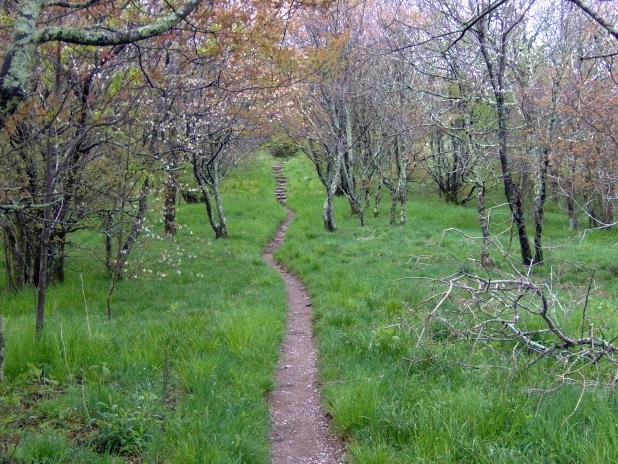
Some of the more favorable trails were actually railroad beds at one time, as they are affectionately known as 'rail trails'.  These trails make hiking a breeze, due to the fact that there are no steep inclines, rough or unpredictable terrain, and they are still pretty well covered by wooded areas.  Also, they go were there are often no roads for miles.
The only problem with this method of travel is the fact that there may be no suitable trails in your area, which correspond to your bug out route.  In addition, you may still have to utilize bottlenecked roads to get around bodies of water, canyons, or mountains.  If you are on foot or on a bicycle, this may not be an issue.  One problem to consider about rail trails is the fact that you can often see a mile up and down the path.  This may be good to see folks a long ways off, but they can also see you from a great distance too.  Just be aware, and trust your gut.
-K.H. Danielsen

Tuesday, March 26, 2013

Crucial: Camouflage for Preppers

The most avid and experienced of hunters and soldiers will tell you that having the proper camouflage for the job is almost as important as your choice of rifle.  If you stick out like a sore thumb in the middle of a woodland setting, you not only place yourself at risk of being seen by unfriendly eyes, but you'll also scare away the meat sources on which your sustenance depends.
On the flip-side of that coin, sometimes preppers go for the 'tacti-cool' look.  While there are certain aspects of having head-to-toe MOLLE webbing that are good, the problem is that it will also make you stand out ...especially in an urban environment where people are watching.  Nothing says, 'Hey, I'm dressed suspiciously, so please arrest me, mug me, and take my stuff', like wearing the latest in tactical vests and pouches on your Condor chest-rig.

Too Much Tactical

In an SHTF situation, there will be widespread distress, mayhem, and worst of all, anarchy.  Thomas Hobbes once wrote about anarchy in his work, Leviathan:

"In such condition there is no place for industry, because the fruit thereof is uncertain, and consequently, not culture of the earth, no navigation, nor the use of commodities that may be imported by sea, no commodious building, no instruments of moving and removing such things as require much force, no knowledge of the face of the earth, no account of time, no arts, no letters, no society, and which is worst of all, continual fear and danger of violent death, and the life of man, solitary, poor, nasty, brutish, and short."
 Many new preppers believe this to be a time to gird themselves in their most awesome tactical (ahem... airsoft) gear and hit the streets.  But in a world where life is 'nasty, brutish, and short', I would say that this is a very, very bad idea.
Wearing tactical gear will cause you to stick out in an urban environment, while making you look like a combatant at a distance in a rural/woodland environment.  Not only will you become a target in the eyes of plundering thugs ...but you will also look like a criminal or insurgent to operating police and military.  Especially when the military is attempting to quell dissent and reestablish order, they won't take too kindly to insurgents.  If you look like an insurgent, then you'll be pegged as one ...guaranteed.  Then it's only a matter of waiting to be vaporized by any one of the military's many munitions.  Perhaps the worst part is the fact that they wasted their resources, rounds, and time on you, and didn't blow up the roving packs of lawless looters that they were gunning for in the first place.
Do yourself and everyone else a favor... just look like a peaceful person, and not like an operator from Call of Duty.

Camo ...Done Right.

In an urban environment, you don't want to stick out.  This means that you want to look like just another civilian, trying to survive like everybody else.  However, you don't want to look vulnerable, so you might benefit from dressing in rip-stop cargo pants, and rugged button-down shirts, primarily colored in earth tones.  You want to look smart but not threatening.
In the woods, earth tones are very, very important.  Again, you don't want to look like a combatant in the riflescope of a military recon team, so the key is to dress like a lowly hunter in search of food to put on the table at the homestead.  
For this reason, you should definitely wear camouflage.  Consider wearing patterns from Mossy Oak or RealTree.  Also, some military camouflage patterns aren't bad to wear, especially if the military is not currently employing them.  For instance, you should not wear ACU style camo (as this is currently being worn by soldiers actively being deployed), but the older BDU should be suitable, especially in a woodland environment.  Many hunters wear this type of camo as well, so you should not look too suspicious.
If you absolutely do not want to be seen, then you should wear ghillie type material over your camouflage clothing.  Online and store-bought ghillie suits are grossly overpriced and often ineffective. We recommend simply making your own ghillie-style poncho or covering, while keeping your chest area uncovered (it won't snag while you are stalking from a ground position).  Making your own is simple and it is easy to learn, as there are hundreds of tutorials that can easily be found online.  
Not only will making your own ghillie covering be cheaper, but it offers superior camouflage against unfriendly eyes, as well as unsuspecting game.
For covering your skin, you can find cloves and face covers in hunting stores that will do the job just fine.  If you're short on those resources, a little mud and dirt can go a long way.

If You Want To Be Seen

Sometimes, you absolutely, positively want to be seen.  It would be a smart idea to carry a blaze orange bandana (or some other type of cover) in a closed pocket at all times.  The key to effective and smart camo is the ability to be seen ...only when you want to.  
Also, carrying a blaze orange poncho could cover you entirely, while having the capacity to roll up and be stored in a very small space.  
Most of the time, we don't want to be noticed when out in the wild.  But there are certain times, especially when there is an emergency, when attracting attention may just save your life.

Monday, March 18, 2013

Perimeter Trip Wire and Bang Alarm ...For Under $5

Living through a zombie apocalypse is hard enough while you're awake.  Now imagine trying to get a good night's sleep, knowing that in any moment, your camp might be visited by an unwelcome guest who's sniffing out a quick meal.
Well, here are two very inexpensive ways to ensure that you won't be caught by surprise...


Gotta love YouTube...
-K.H. Danielsen

Friday, March 15, 2013

Buggin-In Essential Strategies

Most of us have heard of the term, 'bugging out', which was originally coined during the Korean Conflict.  The exact opposite would be 'buggin in', or the hunkering down to wait for the crisis to blow over.  Bugging-in strategies do have their advantages.

For instance, while you are bugging out, you have to worry about logistics, routes, weight, mobility, and you leave yourself rather exposed while in transit.  Also, for those of us who prefer to bug out, we have to have a place to where we can evacuate.  There is no sense in evacuating, only to get lost in the middle of a crowd of refugees.
For those of us who are bugging in when things go bad, there is the advantage of having storage space, fortification, and even avoiding the prospect of being out in the open.  However, there are a few things the hunkering prepper may want to consider first...

Space and Security

When deciding to bug in, you'll need to have a look at your own property.  Does it have adequate space in order to support life when the grid goes down? What modifications are you going to have to make?  Can your position be fortified in the event of a crisis?  
There are two types of scenarios that may make you want to change your strategy to an evacuation:

First, you will want to leave if you don't have enough space, such as in a highly populated urban zone, or your property is too small.  Especially, in a densely populated area, your level of space and security are very low.  Not only is there a high probability of contact with hostiles, but you are also in no position to have enough storage space to support yourself and your peers.
The second is that you might have a property that is out in the open, such as a farm or ranch.  Contrary to popular belief, these types of properties are not suitable for a buggin in strategy, as they are totally exposed, often being visible for miles.  Staying on a farm is like hanging up a sign that says, 'Take our ample supply of food!'  History has shown us that when cities evacuate, the refugees pick the outlying countryside farms clean of their crops.  You might be high on space, but you will be very low on security.

Bugging in, if you live in a small town, can go either way, as this depends on your own preparations.  Suburban areas can support life, especially if you have a fenced-in back yard.  One of the advantages to   suburbs is the fact that all the houses tend to look the same.  Other houses can provide your own homestead with cover, and finding your house is like trying to locate a single card in an entire deck: it's possible, but it will take a while.  Of course, you still run the risk of being looted, as suburban areas are still considered densely populated, but you will have a higher probability of success than you might in a high-rise apartment building.

The Ideal

The absolute best kind of bug in location is one where you are able to have an underground fallout shelter, stocked with supplies enough for at least one month, you are in a wooded area that provides cover and makes your shelter hard to identify from afar, and you have enough land to use as a homestead.  Also, properties that back up against state game lands are highly valuable, as this will allow you to take game without ever having to set foot on the road.
Another excellent attribute to a bug in location would be one where you are situated on the side of a hill.  Not only would you have the hill as cover, but to approach your shelter, you would have to come up from the low ground.  This would provide both cover and security.
Do keep in mind, that you will have to develop the resources and space on your property, as you will need a way to remove waste, collect water, store water, store food, and you will also have to have security measures.  The ability to fortify your position is the hallmark of an ideal bug in shelter.
-K. H. Danielsen

Wednesday, March 13, 2013

Your Bug-Out Route: 3 Crucial Rules

For many preppers, 'bugging-out' (evacuating your area in the event of a crisis) is perhaps the only strategy that is a viable option, especially for those of us living in highly populated areas.  If an apocalyptic scenario occurs, it is important to have a place to go when things get rough at the homestead. 
However, simply hopping in the car and driving wildly until you run out of gas is not a very smart idea.   You don't want to be caught out in the open with no knowledge of where you are.  Also, history has shown us that when there is a mass exodus of refugees from highly populated areas, certain zones end up with thousands of vehicles in endless lines on the road with no drivers and empty gas tanks.  You don't want to find yourself in that situation, so you may want to pay attention to these 3 crucial rules for formulating your bug-out strategy.

  1. Know Where You're Going - There really is no point for bugging-out of a certain area if you have no idea where you're going.  Your first, and most important rule in bugging-out is to have a destination in mind.  Whether it's a cabin in the woods, a friend's couch, a church basement, or even an uninhabited patch of land in the middle of nowhere, it is better to have a place than run wildly into the countryside.  The first reason is that you can go to a secure area.  The second is that you can create a plan on how to get there.
  2. Have an Evacuation Plan - Having an evacuation plan, or a bug-out route, is absolutely critical for arriving safely at your destination when a crisis occurs.  The reason for this is the fact that mayhem tends to make improvisation almost impossible, as there are more wild variables in play, such as damaged infrastructure and break-down of social order.  But, if you have a plan, you can eliminate those variables by avoiding highly populated zones and highways.  You will want to keep to the back roads as much as possible.
  3. Avoid Bottlenecks - One of the absolute worst things you can do is funnel yourself into an area called a 'bottleneck'.  Essentially, it is a high-value route with no side roads, forcing everyone into a small space.  These become impassible very quickly if there is panic, so be sure to stay away from them as much as possible.  The most common bottlenecks are going to be roads that cross highway exits, bridges, and mountain passes.  Also, be sure to avoid geographical bottlenecks, such as roads that are sandwiched between a mountain or canyon and a body of water.  The key is, you want to be able to easily find an alternate route, because you may end up on foot if aren't keeping this rule in mind.
-K.H. Danielsen

Monday, March 11, 2013

5 Tips For Prepping On a Budget


Anyone who watches the news these days tends to get creepy stomach-pit feeling that it might be a prudent idea to prepare for unfortunate events that are coming our way.  Especially after a natural disaster, false-flag attack, or a pandemic like the so-called 'swine flu', it is very easy to slip into the ...'I have to prepare as soon as possible, or else...' mindset.
However while it is the state of any person to want to survive, sometimes hysteria, rather than logic, can take control of our minds.  It is never smart to live in fear, as fear tends to make us do things that a calm mind tends to avoid.  The point is, the moment something happens, don't bankrupt your checking account in order to buy the coolest, latest survival toys.  Here are 5 tips that you can employ, so that you can prepare without cashing out your life savings:


  1. Keep your own day-to-day budget in mind.  If you are new to prepping, it is easy to make a list of things to buy, and before you know it, you've blown a couple grand.  The key is to make sure you know your own budget, you know how much 'walking around money' you have to spend, and you know where you can cut here to add there.  You don't want to be in a position where you can't make a mortgage payment, because you decided to stock up on ammunition and dehydrated food.
  2. Prep slowly.  If you make your preps steadily and slowly, you will have two advantages.  First, it will be much easier on the savings account, especially if you're someone (like most of us) who are living paycheck-to-paycheck.  The second advantage is one to which any seasoned prepper can attest: the slower you prep, the more you can learn before you buy.  Most preppers end up starting out by buying a ton of gear early on, and then realize to their dismay that they either spent too much or bought the wrong things to accommodate their system.  
  3. Research, research, and then... research some more.  Perhaps the most important item you can have in your kit is going to be the cheapest, ways nothing, and it can never be exhausted: knowledge.  Having a thorough knowledge of your particular system can save you a great deal of money.  For instance, while you might spend thousands on Internet-bought food stores, learning how to jar food from your home garden will be more effective and much cheaper for you in the long-run. 
  4. Do-It-Yourself.  It's amazing how much things cost, especially when you add up the extras.  Take firearms for example... Sure, you can buy a shiny new Ruger revolver ($499), but then you've got to buy rounds ($439 per 1000), a holster ($57.22), and perhaps even a safe place to store it when it's not on  your hip ($100).  Before you know it, you've spent $1095.22 on only one weapon system.  Instead, you would be able to save quite a bit of money manufacturing some of these things yourself.  Of course, you couldn't make your own revolver ...but, you could reload your own rounds, make your own holster from Kydex, and even construct your own gun safe.  The possibilities are endless when you do it yourself.  Don't always think you have to buy, when sometimes you can make your own ...for a fraction of the price.
  5. Know People.  Any prepper worth his or her salt will tell you to either create or join a network of likeminded folks, as there are many advantages in doing so.  First, it will add peace of mind in knowing that you're not alone, and allow you to rely on others for encouragement.  Second, it will increase your ability to survive, as more people have a wider array of special skills from hunting to innovation to medical care ...meaning that you don't have to be a jack of all trades.  And third, it will give preppers the ability to pool resources, meaning that you don't have to be completely and totally self-sufficient, as this can become extremely expensive.  You might be placed in charge of purchasing communications and navigational gear, while others might be in charge of medical supplies, and someone else may be in charge of food acquisition.  You can concentrate and spend your money on your specialty, saving everyone money.  Usually, if you are interested in a certain aspect of survival, you'll know where to get the best deals. 
-K.H. Danielsen

Thursday, March 7, 2013

Zombies: A Living History


This is an extremely interesting documentary from the History Channel, discussing how humanity has always been afraid of the undead.  One record goes all the way back to the 18th Century BC in the Epic of Gilgamesh, where Ishtar says"I shall raise up the dead and they shall eat the living... I shall make the dead outnumber the living."  Well if that's the case, looks like I'll be sharpening my Kukri.

-K.H. Danielsen