Thursday, March 28, 2013

Trails and Rails: Off Road Bugout Strategy

If your strategy is to hit the road when the SHTF, then you might already be aware of just how risky that trip might be when the time comes.  The problem is that you might be one person in millions that will take to the streets when disaster strikes; and the more people that are in your area, the higher the chances that you will run into problems.  Especially if you live in an urban zone, this becomes even more of an issue.
In effect, here are two excellent alternate routes that you might want to take in the event of a societal collapse that forces you from your bunker.  Of course, be prepared to leave the automobile in the garage...

#1  Railroad Tracks

One type of infrastructure that the US has had since late in the 19th century was the railroad system.  Railroads cover the continental US (and even southern Alaska), networking from urban sprawl to sparse countryside to the remote wilderness.
Railroads cross state lines, they can go over rivers, they can cut through the mountains, and give you an easy pass through just about any terrain that you might consider to be problematic.  An excellent aspect about using rail lines is the fact that most refugees will be stuck on roads.  Especially in the event that you must travel over a body of water, everyone else will be locked in traffic trying to cross...but you won't have that problem, since there will be a fraction of the people and no cars on the railroad bridge.  Also, rail lines are just about everywhere, which means that the majority of your trip can be easy going with no rough terrain.
The only problems you might want to consider are the danger's of travelling on railroads.  First, if the railroads are still being used by locomotives, you should not travel on the train tracks themselves; instead, travel next to them.  Second, railroad networks will sometimes lead you into very, very populated areas.  Obviously, you should do your uttermost to avoid such areas, so be aware of where the rail system takes you.  If possible, acquire the appropriate maps in order to plan your route.  Again, stay away from urban areas.  Last, this type of route will only work if you are using an off-road vehicle, mountainbike, or your feet.

#2  Trails

If you have an abundance of trails in your area, be sure to check where they are to see if your bug out route corresponds.  If they do, then you're in luck.
Trails that cover long distances are almost always going to avoid heavily populated areas (or at least skirt around them).  This means that you will have very few problems along the way, due to the few amount of travelers you might encounter.  While these might not cross over bodies of water and other geological structures without using road systems, the majority of your travels will be moving through farmlands and woodlands.  These areas will also have abundant amounts of game.
You will have no shortage of places to pitch camp, and even collect water (depending on your region). Also, these trails are often winding through very dense wilderness, giving you a fantastic blanket of cover.
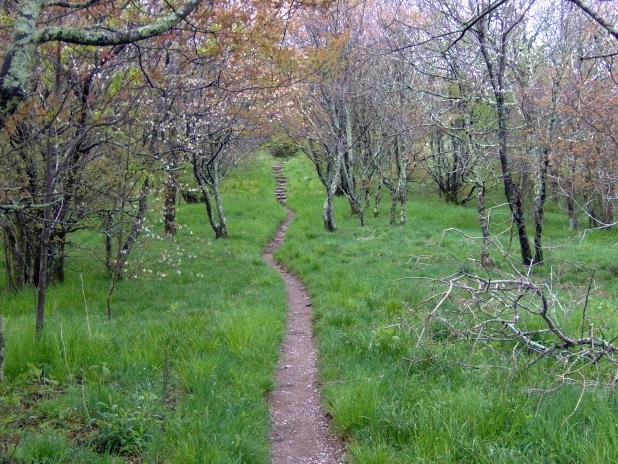
Some of the more favorable trails were actually railroad beds at one time, as they are affectionately known as 'rail trails'.  These trails make hiking a breeze, due to the fact that there are no steep inclines, rough or unpredictable terrain, and they are still pretty well covered by wooded areas.  Also, they go were there are often no roads for miles.
The only problem with this method of travel is the fact that there may be no suitable trails in your area, which correspond to your bug out route.  In addition, you may still have to utilize bottlenecked roads to get around bodies of water, canyons, or mountains.  If you are on foot or on a bicycle, this may not be an issue.  One problem to consider about rail trails is the fact that you can often see a mile up and down the path.  This may be good to see folks a long ways off, but they can also see you from a great distance too.  Just be aware, and trust your gut.
-K.H. Danielsen

Tuesday, March 26, 2013

Crucial: Camouflage for Preppers

The most avid and experienced of hunters and soldiers will tell you that having the proper camouflage for the job is almost as important as your choice of rifle.  If you stick out like a sore thumb in the middle of a woodland setting, you not only place yourself at risk of being seen by unfriendly eyes, but you'll also scare away the meat sources on which your sustenance depends.
On the flip-side of that coin, sometimes preppers go for the 'tacti-cool' look.  While there are certain aspects of having head-to-toe MOLLE webbing that are good, the problem is that it will also make you stand out ...especially in an urban environment where people are watching.  Nothing says, 'Hey, I'm dressed suspiciously, so please arrest me, mug me, and take my stuff', like wearing the latest in tactical vests and pouches on your Condor chest-rig.

Too Much Tactical

In an SHTF situation, there will be widespread distress, mayhem, and worst of all, anarchy.  Thomas Hobbes once wrote about anarchy in his work, Leviathan:

"In such condition there is no place for industry, because the fruit thereof is uncertain, and consequently, not culture of the earth, no navigation, nor the use of commodities that may be imported by sea, no commodious building, no instruments of moving and removing such things as require much force, no knowledge of the face of the earth, no account of time, no arts, no letters, no society, and which is worst of all, continual fear and danger of violent death, and the life of man, solitary, poor, nasty, brutish, and short."
 Many new preppers believe this to be a time to gird themselves in their most awesome tactical (ahem... airsoft) gear and hit the streets.  But in a world where life is 'nasty, brutish, and short', I would say that this is a very, very bad idea.
Wearing tactical gear will cause you to stick out in an urban environment, while making you look like a combatant at a distance in a rural/woodland environment.  Not only will you become a target in the eyes of plundering thugs ...but you will also look like a criminal or insurgent to operating police and military.  Especially when the military is attempting to quell dissent and reestablish order, they won't take too kindly to insurgents.  If you look like an insurgent, then you'll be pegged as one ...guaranteed.  Then it's only a matter of waiting to be vaporized by any one of the military's many munitions.  Perhaps the worst part is the fact that they wasted their resources, rounds, and time on you, and didn't blow up the roving packs of lawless looters that they were gunning for in the first place.
Do yourself and everyone else a favor... just look like a peaceful person, and not like an operator from Call of Duty.

Camo ...Done Right.

In an urban environment, you don't want to stick out.  This means that you want to look like just another civilian, trying to survive like everybody else.  However, you don't want to look vulnerable, so you might benefit from dressing in rip-stop cargo pants, and rugged button-down shirts, primarily colored in earth tones.  You want to look smart but not threatening.
In the woods, earth tones are very, very important.  Again, you don't want to look like a combatant in the riflescope of a military recon team, so the key is to dress like a lowly hunter in search of food to put on the table at the homestead.  
For this reason, you should definitely wear camouflage.  Consider wearing patterns from Mossy Oak or RealTree.  Also, some military camouflage patterns aren't bad to wear, especially if the military is not currently employing them.  For instance, you should not wear ACU style camo (as this is currently being worn by soldiers actively being deployed), but the older BDU should be suitable, especially in a woodland environment.  Many hunters wear this type of camo as well, so you should not look too suspicious.
If you absolutely do not want to be seen, then you should wear ghillie type material over your camouflage clothing.  Online and store-bought ghillie suits are grossly overpriced and often ineffective. We recommend simply making your own ghillie-style poncho or covering, while keeping your chest area uncovered (it won't snag while you are stalking from a ground position).  Making your own is simple and it is easy to learn, as there are hundreds of tutorials that can easily be found online.  
Not only will making your own ghillie covering be cheaper, but it offers superior camouflage against unfriendly eyes, as well as unsuspecting game.
For covering your skin, you can find cloves and face covers in hunting stores that will do the job just fine.  If you're short on those resources, a little mud and dirt can go a long way.

If You Want To Be Seen

Sometimes, you absolutely, positively want to be seen.  It would be a smart idea to carry a blaze orange bandana (or some other type of cover) in a closed pocket at all times.  The key to effective and smart camo is the ability to be seen ...only when you want to.  
Also, carrying a blaze orange poncho could cover you entirely, while having the capacity to roll up and be stored in a very small space.  
Most of the time, we don't want to be noticed when out in the wild.  But there are certain times, especially when there is an emergency, when attracting attention may just save your life.

Monday, March 18, 2013

Perimeter Trip Wire and Bang Alarm ...For Under $5

Living through a zombie apocalypse is hard enough while you're awake.  Now imagine trying to get a good night's sleep, knowing that in any moment, your camp might be visited by an unwelcome guest who's sniffing out a quick meal.
Well, here are two very inexpensive ways to ensure that you won't be caught by surprise...


Gotta love YouTube...
-K.H. Danielsen

Friday, March 15, 2013

Buggin-In Essential Strategies

Most of us have heard of the term, 'bugging out', which was originally coined during the Korean Conflict.  The exact opposite would be 'buggin in', or the hunkering down to wait for the crisis to blow over.  Bugging-in strategies do have their advantages.

For instance, while you are bugging out, you have to worry about logistics, routes, weight, mobility, and you leave yourself rather exposed while in transit.  Also, for those of us who prefer to bug out, we have to have a place to where we can evacuate.  There is no sense in evacuating, only to get lost in the middle of a crowd of refugees.
For those of us who are bugging in when things go bad, there is the advantage of having storage space, fortification, and even avoiding the prospect of being out in the open.  However, there are a few things the hunkering prepper may want to consider first...

Space and Security

When deciding to bug in, you'll need to have a look at your own property.  Does it have adequate space in order to support life when the grid goes down? What modifications are you going to have to make?  Can your position be fortified in the event of a crisis?  
There are two types of scenarios that may make you want to change your strategy to an evacuation:

First, you will want to leave if you don't have enough space, such as in a highly populated urban zone, or your property is too small.  Especially, in a densely populated area, your level of space and security are very low.  Not only is there a high probability of contact with hostiles, but you are also in no position to have enough storage space to support yourself and your peers.
The second is that you might have a property that is out in the open, such as a farm or ranch.  Contrary to popular belief, these types of properties are not suitable for a buggin in strategy, as they are totally exposed, often being visible for miles.  Staying on a farm is like hanging up a sign that says, 'Take our ample supply of food!'  History has shown us that when cities evacuate, the refugees pick the outlying countryside farms clean of their crops.  You might be high on space, but you will be very low on security.

Bugging in, if you live in a small town, can go either way, as this depends on your own preparations.  Suburban areas can support life, especially if you have a fenced-in back yard.  One of the advantages to   suburbs is the fact that all the houses tend to look the same.  Other houses can provide your own homestead with cover, and finding your house is like trying to locate a single card in an entire deck: it's possible, but it will take a while.  Of course, you still run the risk of being looted, as suburban areas are still considered densely populated, but you will have a higher probability of success than you might in a high-rise apartment building.

The Ideal

The absolute best kind of bug in location is one where you are able to have an underground fallout shelter, stocked with supplies enough for at least one month, you are in a wooded area that provides cover and makes your shelter hard to identify from afar, and you have enough land to use as a homestead.  Also, properties that back up against state game lands are highly valuable, as this will allow you to take game without ever having to set foot on the road.
Another excellent attribute to a bug in location would be one where you are situated on the side of a hill.  Not only would you have the hill as cover, but to approach your shelter, you would have to come up from the low ground.  This would provide both cover and security.
Do keep in mind, that you will have to develop the resources and space on your property, as you will need a way to remove waste, collect water, store water, store food, and you will also have to have security measures.  The ability to fortify your position is the hallmark of an ideal bug in shelter.
-K. H. Danielsen

Wednesday, March 13, 2013

Your Bug-Out Route: 3 Crucial Rules

For many preppers, 'bugging-out' (evacuating your area in the event of a crisis) is perhaps the only strategy that is a viable option, especially for those of us living in highly populated areas.  If an apocalyptic scenario occurs, it is important to have a place to go when things get rough at the homestead. 
However, simply hopping in the car and driving wildly until you run out of gas is not a very smart idea.   You don't want to be caught out in the open with no knowledge of where you are.  Also, history has shown us that when there is a mass exodus of refugees from highly populated areas, certain zones end up with thousands of vehicles in endless lines on the road with no drivers and empty gas tanks.  You don't want to find yourself in that situation, so you may want to pay attention to these 3 crucial rules for formulating your bug-out strategy.

  1. Know Where You're Going - There really is no point for bugging-out of a certain area if you have no idea where you're going.  Your first, and most important rule in bugging-out is to have a destination in mind.  Whether it's a cabin in the woods, a friend's couch, a church basement, or even an uninhabited patch of land in the middle of nowhere, it is better to have a place than run wildly into the countryside.  The first reason is that you can go to a secure area.  The second is that you can create a plan on how to get there.
  2. Have an Evacuation Plan - Having an evacuation plan, or a bug-out route, is absolutely critical for arriving safely at your destination when a crisis occurs.  The reason for this is the fact that mayhem tends to make improvisation almost impossible, as there are more wild variables in play, such as damaged infrastructure and break-down of social order.  But, if you have a plan, you can eliminate those variables by avoiding highly populated zones and highways.  You will want to keep to the back roads as much as possible.
  3. Avoid Bottlenecks - One of the absolute worst things you can do is funnel yourself into an area called a 'bottleneck'.  Essentially, it is a high-value route with no side roads, forcing everyone into a small space.  These become impassible very quickly if there is panic, so be sure to stay away from them as much as possible.  The most common bottlenecks are going to be roads that cross highway exits, bridges, and mountain passes.  Also, be sure to avoid geographical bottlenecks, such as roads that are sandwiched between a mountain or canyon and a body of water.  The key is, you want to be able to easily find an alternate route, because you may end up on foot if aren't keeping this rule in mind.
-K.H. Danielsen

Monday, March 11, 2013

5 Tips For Prepping On a Budget


Anyone who watches the news these days tends to get creepy stomach-pit feeling that it might be a prudent idea to prepare for unfortunate events that are coming our way.  Especially after a natural disaster, false-flag attack, or a pandemic like the so-called 'swine flu', it is very easy to slip into the ...'I have to prepare as soon as possible, or else...' mindset.
However while it is the state of any person to want to survive, sometimes hysteria, rather than logic, can take control of our minds.  It is never smart to live in fear, as fear tends to make us do things that a calm mind tends to avoid.  The point is, the moment something happens, don't bankrupt your checking account in order to buy the coolest, latest survival toys.  Here are 5 tips that you can employ, so that you can prepare without cashing out your life savings:


  1. Keep your own day-to-day budget in mind.  If you are new to prepping, it is easy to make a list of things to buy, and before you know it, you've blown a couple grand.  The key is to make sure you know your own budget, you know how much 'walking around money' you have to spend, and you know where you can cut here to add there.  You don't want to be in a position where you can't make a mortgage payment, because you decided to stock up on ammunition and dehydrated food.
  2. Prep slowly.  If you make your preps steadily and slowly, you will have two advantages.  First, it will be much easier on the savings account, especially if you're someone (like most of us) who are living paycheck-to-paycheck.  The second advantage is one to which any seasoned prepper can attest: the slower you prep, the more you can learn before you buy.  Most preppers end up starting out by buying a ton of gear early on, and then realize to their dismay that they either spent too much or bought the wrong things to accommodate their system.  
  3. Research, research, and then... research some more.  Perhaps the most important item you can have in your kit is going to be the cheapest, ways nothing, and it can never be exhausted: knowledge.  Having a thorough knowledge of your particular system can save you a great deal of money.  For instance, while you might spend thousands on Internet-bought food stores, learning how to jar food from your home garden will be more effective and much cheaper for you in the long-run. 
  4. Do-It-Yourself.  It's amazing how much things cost, especially when you add up the extras.  Take firearms for example... Sure, you can buy a shiny new Ruger revolver ($499), but then you've got to buy rounds ($439 per 1000), a holster ($57.22), and perhaps even a safe place to store it when it's not on  your hip ($100).  Before you know it, you've spent $1095.22 on only one weapon system.  Instead, you would be able to save quite a bit of money manufacturing some of these things yourself.  Of course, you couldn't make your own revolver ...but, you could reload your own rounds, make your own holster from Kydex, and even construct your own gun safe.  The possibilities are endless when you do it yourself.  Don't always think you have to buy, when sometimes you can make your own ...for a fraction of the price.
  5. Know People.  Any prepper worth his or her salt will tell you to either create or join a network of likeminded folks, as there are many advantages in doing so.  First, it will add peace of mind in knowing that you're not alone, and allow you to rely on others for encouragement.  Second, it will increase your ability to survive, as more people have a wider array of special skills from hunting to innovation to medical care ...meaning that you don't have to be a jack of all trades.  And third, it will give preppers the ability to pool resources, meaning that you don't have to be completely and totally self-sufficient, as this can become extremely expensive.  You might be placed in charge of purchasing communications and navigational gear, while others might be in charge of medical supplies, and someone else may be in charge of food acquisition.  You can concentrate and spend your money on your specialty, saving everyone money.  Usually, if you are interested in a certain aspect of survival, you'll know where to get the best deals. 
-K.H. Danielsen

Thursday, March 7, 2013

Zombies: A Living History


This is an extremely interesting documentary from the History Channel, discussing how humanity has always been afraid of the undead.  One record goes all the way back to the 18th Century BC in the Epic of Gilgamesh, where Ishtar says"I shall raise up the dead and they shall eat the living... I shall make the dead outnumber the living."  Well if that's the case, looks like I'll be sharpening my Kukri.

-K.H. Danielsen

Wednesday, March 6, 2013

Preparedness Not Just For Preppers

I've found it interesting how some folks don't see the need to prepare for future disaster.  They rationalize by saying something like...  "Why should I stock up on food and water supplies?  I've got a grocery store five blocks down the street, and I'm just living paycheck to paycheck.  Besides, I'm no 'prepper', and I don't think the end of the world will be here anytime soon."
Just for argument's sake, let's say that a worldwide zombie pandemic were not imminent, and that no war, pestilence, economic collapse, an EMP, or attack of the rabid unicorns were coming to our cities and towns.  Life will be hunky-dory for the next 200 years, so there's nothing to worry about.  (Though, you know I really don't see things that optimistically, as realism is my curse, just bear with me) I would have to argue the case for you to prepare for disaster nonetheless.

Hunnie, we've been attacked by zombies... can we finally break out the 'tactical bacon'??

There Will Always Be Disaster

On this third rock from that big shiny thing called the sun, disaster is at every turn.  No, it may not come as a zombie apocalypse today, but it has a good chance of coming into our lives as a layoff, a snowstorm, or a giant gust of wind that topples that giant oak onto the transformer across the street.  These events don't really seem like something for which we should stock up the pantry.  But, think about how they can affect our daily lives...
Without power, you can't cook, turn on a light switch, wash your clothes (and you can't even post your predicament on Facebook).  You won't even be able to flip on the TV and see just how widely the power outage has spread.  Who knows, the entire country may have gone dark, and you might not even know it.  If it happens in the winter, how will you keep warm?  Do you have candles or lanterns?  Do you have a gas powered stove or grill so you can cook?  How much of your food supplies in your fridge and freezer will be lost, and do you have nonperishable food that you can consume for the duration of the event?  Do you have a way to bathe?  Do you have a way to get rid of sewage?  As you can see, the questions are endless.
Devastation.


My thoughts also drift towards the beaches of New Jersey, during the aftermath of hurricane Sandy.  Those unfortunate events were flashed all over national news, as folks stood guard on their front porches with 12ga shotguns to prevent their homes from being looted.  Yes, there were plenty of grocery stores just down the road, but you can bet that those establishments were rendered useless without a working power grid.  It was also interesting how even cars are dependent on the power grid, as it requires this grid in order to pump the gas.  For this reason, folks were parked in gas lines for hours on end.  Fights broke out on a regular basis, due to unjust 'line cutters'.  It's interesting how our more aggressive natures tend to surface when resources are in short supply.


Perhaps, even if you don't fancy yourself a prepper, you might consider preparing nonetheless.  No, you don't have to prepare for a zombie apocalypse, but who knows when the next bad storm will blow through, and your stuck with eating PBJ's for the next week and a half.  Personally though, if I've got chunky peanut butter, even I might not mind that.
-K. H. Danielsen

Tuesday, March 5, 2013

A Case For the Kukri

When you're 'bugging in', there really is no limit to how heavy your gear and supplies can be.  Folks who are crafting their zombie apocalypse survival strategy to bug in have the main advantage of not worrying about weight and portability (for the most part), which means that much of their gear can have specific purposes.  For instance, they can buy a knife for working, and then another for fighting.
For those of us who are 'bugging out', our gear must be light, portable, and most of all, multi-purposeful.  The ability to combine two or three tools into one offers the capability of packing the most uses for single items of gear in the least amount of space and weight.  These tools are gold to the zombie survivalist.  Perhaps the best survival tool of them all is the Kukri knife.

The Helper at Camp


Many of us will be making a break for the wild when things go bad, which means that life will be lived at camp and on the trek.  Having a chopping knife is of the uttermost importance, as this will allow you to limb trees, make shelters and other structures, and chop firewood.  While this is mostly a job for an axe, the Kukri knife has been performing this function for hundreds of years in Nepal.  

Gurkha Kukri Knife
The Kukri has several advantages over an axe or tomahawk.  While the Kukri may not be able to down an entire tree the way an axe can, it is perhaps the only type of blade that has the ability to chop through thick limbs, even making quick work of wood for the fire.  At the same time, the blade profile allows for hacking away at weeds and dense brambles, something an axe cannot do.  It doubles its function as both a knife and a machete, carrying all the advantages and very few of the drawbacks.
**Note:  I'm not saying to leave the axe at home.  Axes and hatchets are indispensable for a long-term self-reliance scenario, especially if you want to hammer stakes and build a more permanent structure... however, for a short term scout, Kukri's become a fantastic alternative.  Not only that, but a Kukri can become ready for a fight quite quickly, whereas an axe or a tomahawk requires more time to unsheath and grab the handle properly.  Food for thought.**

The key is in the Kukri design.  If you refer to the picture above, you will notice that the blade is drawn forward.  This allows for the knife to have the essential 'forward weight' for chopping.  The nature of this design has made the Kukri into one of the most loved tools for bushcrafters and survivalists, due to its ability to fly through any material in its way.  In addition, a traditional Kukri handle has a large swell and a metal pommel at the very end.  This allows the user to keep a tight grip of the blade while swinging into the material.  Because of the capabilities of the Kukri knife, it has been the primary farming, jungle, and weapon of war for the highly renowned Gurkhas ...a people known for their horrific and awe inspiring deeds in battle... which brings us to the Kukri's second most important function.

The Decapitator

The Kukri didn't exactly receive its fame from being a useful tool in the jungles of Nepal.  The reason that tales of the blade travelled around the world was in its ability to hack through enemy soldiers.  Essentially, the Kukri is designed as a chopper.  The means that any time the Gurkhas came up against enemy soldiers in close combat ...one expected decapitations and dismemberment.
In fact, the Kukri's halmark design with the notching just above the handle has two purposes.  The first is ceremonial, as the notching resembles the hoof of a cow, reminding the Gurkhas to never kill the sacred Hindu beast.  The second is deadly, as the notching stops blood from dripping into the handle,  which makes it slick and affecting the fighter's ability to hang on to the blade while swinging.
In addition to the 'weight forward' design, the forward drawn angle of the blade prevents the fighter from having to angle his or her wrist while stabbing.
The Kukri is designed to decapitate and dismember the enemy, making it absolutely ideal in the event of a zombie outbreak.  As we all know, the key to disabling a zombie is to remove its head or destroy its brain stem.  The Gurkha Kukri knife is specifically designed to accomplish this task on coordinated, agile, and strong enemy soldiers ...to strike a well-placed blow from a Kukri across the neck of a hobbling, staggering zombie would be a rather simple, quick task.  Just ask Alice, she figured that out in Resident Evil: Extinction.

Even the fast ones can't stand up to dual wielded 'Kuks'

There you have it, folks.  The Kukri is perhaps the most useful blade you can ever possess in the event of a zombie pandemic.  Not only can it give you great service at camp, but these blades will make decapitating the undead look easy.
-K. H. Danielsen

Monday, March 4, 2013

Quick Fire, Sure Fire

Creating fire is perhaps one of the most essential of all survival skills.  Now, many believe that starting a fire is rather easy (heck, Hollywood makes it look easy).  However, starting a fire does require some skill and practice, along with a basic knowledge of various methods.  Let's just say, you'll be sorely disappointed if you try to start a fire by holding a burning match under a wet log.
Fire provides light and warmth.  It can keep you comfortable, both physically and mentally.  It can provide a nice, hot, well-cooked meal, and even purify your water by boiling.  Fire is one of the most necessary keys to unlocking wilderness self-reliance.  The kicker is getting one started.


Quick Fire

Here's a quick method on getting a fire going, provided you're in dry conditions:

First, you will want to gather your small, pencil-lead-thick branches.  Be sure to gather at least two handfuls.  The more you have, the less of a chance that you'll have to leave your fire unattended to find more.  Next, you'll want to gather four handfuls of pencil-thick branches, and then fill your arms with thumb-thick branches.  Once you've got your piles of sticks, then you'll want to sort them into sizes.

Your next step is to get out your ferro-rod (firesteel) and your fire starter.  My personal favorite is a prescription drug canister with petroleum jelly-coated cotton balls.  All I do is dip a cotton ball in the petroleum jelly, and stuff it into a small pill canister.  As you pack them in, they become more saturated.  The petroleum jelly acts as a coal extender, which means that your cotton ball will still light quite easily with a strike or two of the ferro-rod, but will burn for up to 5 minutes.  This allows for plenty of time to get your tinder going.

Be sure that you have a wide piece of bark on the ground as your fire lay, shielding your cotton ball from any ground moisture.  Next to the bark, place a forearm-thick log that's about a foot long.  Place your cotton ball on the bark, then strike your ferro-rod so that the sparks land on it.  This will get a flame going quite quickly.
Next, get your pencil lead-thick sticks and lay them just above the burning cotton ball by leaning them against the forearm-thick log.  The cool part about this method is that it places these thin sticks where the flame is the hotest.  Also, if your fire is being starved of oxygen, simple lift up on the log and the flame will become bigger.  Once those smaller sticks are going, then slowly work your way up to the thumb-thick sticks.  The time to start this type of fire should be no more than 7 minutes.

Sure Fire

Having the ability to create 'sure fire' is extremely important in a survival-type or long term sustainability scenario.  There are times when having fire can be life-saving, especially in cases of onsetting hypothermia.  In addition, during these times when fire is that important, it tends to be during times when the setting is the least facilitating for creating fire.  For instance, you will probably not need to affect fire in the event that your stuck in the woods on a sunny, 90-degree day.  However, fire becomes a necessity when it's cold, windy, and wet ...about the worst conditions for getting a fire going.
So, the key is to have fire starting fuel that will burn every time ... even when it's cold, windy, and wet. One of the best types of fuel for this job is Trioxane.  You can usually find this in military surplus stores, and especially online.  Trioxane fuel comes in bars, and usually only take a couple strikes on the ferro-rod to get going.  The nice part about this particular fuel is the fact that it burns, even when conditions are wet and windy.
Also, WetFire is another excellent tinder, which can even burn while it's floating.  The only drawback to WetFire is that it's a bit more expensive than the Trioxane bars.  However, sometimes having sure fire is worth the additional cost.

Once you've lit the Trioxane or WetFire, simply repeat the steps above in the 'quick fire' section, and there you go.  Whether you're starting a fire to save your life, or just impressing your friends that you didn't even need matches or a lighter... having this skill in your brain tool box is definitely one that can come in handy!
-K. H. Danielsen

Friday, March 1, 2013

Federal Government: The Zombies Are Coming! The Zombies Are Coming!

There was a time when the lowly zombie only found a home in Hollywood, independent films, books, comics, and, of course... video games.  We could all be horrified, nauseated by the insurmountable content of gore, and especially entertained when one gets bludgeoned to undeath by a cricket bat.  Then, by the end of the movie, we could all sit back and relax ...that guy eating the other guy on the side of the road was only 'high on bath salts', and no one actually believes that a zombie apocalypse was nigh.

However...

Recently the CDC (Centers for Disease Control and Prevention) released an info article, talking about how to prepare for a zombie apoca... what?!  Yep, a zombie apocalypse.  You read that correctly.  Of course, the writer of this article and Director of the CDC, Ali S. Khan, did this in a very clever tongue-in-cheek kind of way, but nevertheless, the US Federal Government is now telling the public to prepare for the dead to walk about eating the brains of the living.  ...interesting.

What's Really Happening Here?


Apparently, when the CDC released the report, there was so much buzz about the info article that the site ended up crashing.  Could it really be that the US Federal Government would warn the public about an impending zombie apocalypse?  Truth be told, not really.
The CDC's job is to control or prevent disease and pandemics, with a little disaster management on the side.  The interesting part is when you have a look at what they actually wrote in the article:
"So what do you need to do before zombies…or hurricanes or pandemics for example, actually happen? First of all, you should have an emergency kit in your house. This includes things like water, food, and other supplies to get you through the first couple of days before you can locate a zombie-free refugee camp (or in the event of a natural disaster, it will buy you some time until you are able to make your way to an evacuation shelter or utility lines are restored)."
Ah.  So, they're basically using the coming undead doom as a fun little game to get us to pay attention to the article.  This rag did stir up quite a bit of buzz, so that must have been the goal, right?  Just when we thought it was a joke, Khan goes and writes this:

"If zombies did start roaming the streets, CDC would conduct an investigation much like any other disease outbreak. CDC would provide technical assistance to cities, states, or international partners dealing with a zombie infestation. This assistance might include consultation, lab testing and analysis, patient management and care, tracking of contacts, and infection control (including isolation and quarantine). It’s likely that an investigation of this scenario would seek to accomplish several goals: determine the cause of the illness, the source of the infection/virus/toxin, learn how it is transmitted and how readily it is spread, how to break the cycle of transmission and thus prevent further cases, and how patients can best be treated. Not only would scientists be working to identify the cause and cure of the zombie outbreak, but CDC and other federal agencies would send medical teams and first responders to help those in affected areas (I will be volunteering the young nameless disease detectives for the field work)."

So, in one paragraph, the CDC takes us through what they plan to do in the event of a real zombie apocalypse.  Perhaps, if we were to ask this big wig, if he really believes that a zombie apocalypse were coming ...he'd probably say something like, "You're joking, right?"  No.  This article only gave the CDC a platform to talk about how they would manage a pandemic, while keeping it light and fun.  Of course, I do heartily disagree with the idea of lining up for a stay at Hotel FEMA (I advocate preparing now so you won't be forced to do so), but I see what they're doing here... they're taking a fun little topic and using to talk about a very serious and scary topic.
Interestingly enough, that seems to illustrate the zombie craze in its summation.  It's a disaster scenario of epic proportions, which shuts down the grid, and forces survivors to fight against other bipeds.  Whether those bipeds are undead or not, is irrelevant ...the 'zombie apocalypse' gives the excuse to discuss and prepare for such an unfortunate event.
It seems the federal government has finally caught on to that little fact.

Now, does the CDC actually know of a deadly and highly contagious virus that could trigger the collapse of society and force the rest of us to survive through bullets, blades, and buckets of rice?  I would bet my prepping on it.

-K. H. Danielsen

Thursday, February 28, 2013

Fighting Knife vs. Survival Knife


These days, there seems to be a lot of emphasis on survival knives that are absolutely gargantuan.  At the same time, there are several lines of fighting knives out there from well-known manufacturers that are no more than three inches in length.  But, does the design and makeup of the knife really matter for each application?  I must argue that when it comes to fighting and survival, design and makeup are everything.

Attributes of a Fighting Knife


With a good fighting knife, there can be some leniency in terms of the metal used.  A good fighting knife isn’t required to hold a pristine edge for an extended length of time, for the simple fact that a fight will most likely not last more than a couple seconds, and it will not be subject to very much abuse during the engagement (respectively).  It is for this reason that a lot of fighting knives can be made of cheaper metals, such as inexpensive stainless steel. 
In addition, a good fighting knife needs to be designed to inflict the most damage for the least amount of precision and work.  For instance, though a “tanto” point is pretty much useless as a hunting/survival blade, it is excellent for a fighting knife because it can make quick work of body armor, and it can be used for lighting-fast peripheral strikes.  Also, clip-point blades are great for this application as well, for the simple fact that the tip of the blade has much less material, thereby much less resistance, when stabbing the opponent.  While most survivalists don’t usually fancy a clip-point blade because of their traditional lack of durability in the field, it becomes a great feature for a fighting knife.  For instance, one of Ka-Bar’s most iconic blades, their USMC fighting knife that was first manufactured in the First World War, features a clip-point, allowing for quick penetration of the enemy target.
Also, the USMC Ka-Bar features a metal cross guard.  Again, great for fighting, but for those of us who want to choke up on the blade for leverage for whittling and other camp tasks, it can become quite the hindrance. 
Length is a big factor for fighting knives.  The most prevalent school of thought on fighting knives is that there is no ‘too-long’.  The more reach that knife has, the less of a chance that your opponent can reach back in your direction.  The longer the knife, the more killing distance you have between you and your opponent.  This is why a good fighting knife will boast a blade that is around 5-12 inches.
…Which brings us to ‘survival knives’

The Survival Knife Difference


A survival knife can be both a fighter and a wilderness knife, but it needs to have a very different philosophy of use and different aspects.  For instance, while you might benefit from a ‘tanto’ point in a fight, it makes field dressing a deer or even whittling a difficult and unpredictable chore. 
As I mentioned before, having a long blade is advantageous for combat, but it becomes incredibly cumbersome while performing camp chores.  For instance, if one were to field dress even large game, a long blade would be difficult to handle.  Clipping organs and contaminating the meat becomes almost a certainty.  It is for this reason that most useful wilderness knives stay below the 5-inch range. 
In addition, utilizing a clip-point blade is not easy for the task of gutting game, as nicking organs becomes problematic due to the sharpness and shape of the tip.  (However, keep in mind that clip points are excellent for filleting and skinning).  Also, survival blades will see tremendous amounts of use and abuse, as they will be used on a daily basis; so, ease of sharpening and durability become a very important factor.  This is one reason why the best bushcraft and wilderness survival blades come with either a spear-point or a drop-point.  Also, the quality of steel that makes up the knife becomes crucial in a wilderness survival scenario.  The user will need that knife to hold an edge and to take a beating.  Usually high-carbon steel is the best, though some stainless steels are excellent for use in the field, such as 440C or 154CM, due to their resistance to oxidization.

Tactivival Knife


The Kukri design is unique in that it is a fantastic fighting blade, and an even better survival knife.  It boasts an emphasized weight-forward 'drop-point'.  The Gurkas used these knives for rigorous jungle tasks, but at the same time, their fighting capabilities are legendary.
Overall, the key to any survival/tactical knife will be simplicity.  Added features can be advantageous for specific tasks, but you will be able to perform more tasks more efficiently with a very simple edge and ergonomic handle.  If it feels comfortable in your hand, then you can easily manipulate the blade.  Nothing is more deadly and useful than an edged extension of your own hand.

-K. H. Danielsen

The Wonders of Military Surplus


These days, it seems like ‘survival gear’ has taken on a whole new genre, especially with pop culture touting (or making fun of) the new ‘prepper’ craze.  My thoughts drift to a familiar show on National Geographic, called Doomsday Preppers.  In these shows, you will find the average Joe, attempting to stave off disaster by preparing for it before hand.  The only problem is, the guy spends his entire livelihood on the latest, coolest gear that seems to be ever-so-opportunistically placed on all our favorite doomsday movies.  For instance, I’m reminded of The Book of Eli, when that Oakley logo on his pack always seems to make it into the shot.  Just a little bit of news, that doesn’t happen by accident.
The common misconception is that prepping is too expensive, and that you always need to shop at sporting goods stores to get what you need.  Either that, or you have to spend your life savings on UPS to get it to your house.  Perhaps I may be able to persuade you …there is a better way.
In fact, one of the best places to find your gear is in military surplus stores.  You know the one… it’s that store with the giant machine gun in the front window, furnished with old Marine Corps paraphernalia and decorated with Go Army bumper stickers from 2005.  You can get more than half of what you need from a place such as this.
Now, if you can get past the smell of old canvass and deteriorating leather, there is a wealth of prepper treasures to be found in ‘MilSurp’ stores, due to the philosophy behind ‘Government Issue’.  In any military, the more independent soldiers can be, the easier the logistics are for the chain of command.
For instance, if the military doesn’t provide adequate rain gear for their soldiers, then every time a storm system moves into the zone of operation, the entire army would be logistically hindered.  They would have to spend time changing and drying clothing, erecting shelters, and even tying up the medics from problems with hypothermia.  Clothing wears out much faster when it’s wet and muddy, costing the military millions more than it needs to pay.  So, the military is going to provide excellent rain gear for their troops to keep them on schedule and under budget. 
But, here’s the kicker…
Often times, the military will buy too much of something, meaning that their gear ends up being in surplus (hence the term, ‘military surplus’).  In this small lesson on economics, we find that when something is often in very high supply, then demand is low, leading to that item being very, very cheap for the rest of us. 
This is how you can often find a used military rucksack, one that might cost $300 in the civilian world (for comparable materials), for $50 in a military surplus shop.
In your prepping, be sure that you consider the cheapest route for your gear.  First, always check to see what you can find in the military surplus store before you head out and buy a civilian brand name.  Who knows, you may just come to love the smell of old OD green, Government Issue canvass in the mornin’. 
–K.H. Danielsen